
Learning the official handbook systematically
Level 1: UK Values & Principles
Title:
Level 1: UK Values & Principles
Body:
The fundamental values of British society include: democracy (the right to vote and participate in decision-making), the rule of law (no one is above the law, including government officials), individual liberty (freedom to make choices about your own life), tolerance of those with different faiths and beliefs (respecting diversity), and participation in community life (getting involved in local activities and helping others). These values shape how people interact and how the country is governed. British society expects all citizens to respect these principles, which create a safe, fair, and inclusive environment for everyone regardless of their background.
Level 2: What is the UK?
Title:
Level 2: What is the UK?
Body:
The United Kingdom (UK) is a sovereign country made up of four constituent nations: England, Scotland, Wales, and Northern Ireland. The full name is the United Kingdom of Great Britain and Northern Ireland. 'Great Britain' refers specifically to the largest island which contains England, Scotland, and Wales. The UK is a constitutional monarchy with a parliamentary democracy. The capital cities are: London (England), Edinburgh (Scotland), Cardiff (Wales), and Belfast (Northern Ireland). Each nation has its own distinct culture, traditions, and in some cases, devolved governments with powers over local matters like education and health.
Level 3: Early Britain & The Romans
Title:
Level 3: Early Britain & The Romans
Body:
The first people to live in Britain were hunter-gatherers who arrived after the last Ice Age. Around 4000 BCE, Neolithic farmers began settling, building monuments like Stonehenge. In 43 CE, the Romans invaded Britain under Emperor Claudius. They ruled for nearly 400 years, establishing cities (Londinium, York, Bath), building roads (many still used today), and constructing Hadrian's Wall to protect the northern frontier. The Romans introduced Christianity, writing, and new laws. They left in 410 CE when the Roman Empire was collapsing, leaving Britain vulnerable to invasions from Germanic tribes including the Angles, Saxons, and Jutes.
Level 4: The Anglo-Saxons & Vikings
Title:
Level 4: The Anglo-Saxons & Vikings
Body:
After the Romans left, Angles, Saxons, and Jutes from Germany and Denmark settled in Britain, forming several kingdoms (the Heptarchy) such as Wessex, Mercia, and Northumbria. They introduced the English language, new farming methods, and established shires and counties. Christianity spread throughout England during this period. From the late 8th century, Viking raids began, with Danish Vikings conquering large parts of England (the Danelaw). King Alfred the Great of Wessex defeated the Vikings and united England. Viking influence continued until 1066 when the Norwegian king Harald Hardrada was defeated by King Harold Godwinson at the Battle of Stamford Bridge.
Level 5: 1066 & The Norman Conquest
Title:
Level 5: 1066 & The Norman Conquest
Body:
1066 is the most famous date in English history. After King Edward the Confessor died without an heir, Harold Godwinson was crowned king. However, William, Duke of Normandy (France), claimed he had been promised the throne. William invaded England, and Harold had to march north to defeat a Viking invasion first. The two armies met at the Battle of Hastings on 14 October 1066. Harold was killed (traditionally shot in the eye with an arrow), and William won, becoming King William I (William the Conqueror). This Norman Conquest transformed England: French became the language of the nobility, castles were built across the country, and the feudal system was introduced.
Level 6: The Domesday Book & Feudal System
Title:
Level 6: The Domesday Book & Feudal System
Body:
After becoming king, William the Conqueror ordered a massive survey of all land and property in England to determine who owned what and how much tax they should pay. The results were recorded in the Domesday Book (completed in 1086). It was so thorough that people said nothing escaped it, like the Day of Judgment (Doomsday). The book is still an important historical document today. William also introduced the feudal system: the king owned all land, which he granted to Norman nobles (barons) in exchange for military service. Barons granted land to knights, and peasants (serfs) worked the land in exchange for protection.
Level 7: The Magna Carta (1215)
Title:
Level 7: The Magna Carta (1215)
Body:
King John (reigned 1199-1216) was unpopular because of high taxes and failed wars against France. His barons rebelled and forced him to agree to a document called Magna Carta (Great Charter) at Runnymede in 1215. This was the first time a monarch's power was limited by written law. Key principles included: the king could not tax without the barons' consent, justice could not be sold or denied, and free men could not be imprisoned without a fair trial (habeas corpus). Although originally about the rights of barons, Magna Carta became a symbol of liberty and influenced later documents like the US Constitution and the Universal Declaration of Human Rights.
Level 8: The Model Parliament (1295)
Title:
Level 8: The Model Parliament (1295)
Body:
King Edward I needed money to fund wars in Wales and Scotland. In 1295, he summoned not only nobles and bishops but also two knights from each county and two representatives from each town (burgesses). This gathering became known as the Model Parliament because it set the pattern for future parliaments: it included representatives from different parts of society. This was a key step in the development of the UK Parliament, which now consists of the House of Commons (elected MPs), the House of Lords (appointed peers and bishops), and the Monarch. Parliament's role was to approve taxes and discuss important matters of the kingdom.
Level 9: The Hundred Years’ War (1337-1453)
Title:
Level 9: The Hundred Years' War (1337-1453)
Body:
The Hundred Years' War was a series of conflicts between England and France over who should be king of France (English kings claimed the French throne). Major English victories included the Battles of Crécy (1346) and Agincourt (1415), where English longbowmen defeated French knights. The war inspired English national identity and stories like that of Henry V, made famous by Shakespeare. However, the English were eventually driven out of France, leaving only Calais. The war also contributed to the development of the English Parliament, which gained power as kings needed money for campaigns. Joan of Arc became a French hero during this war.
Level 10: The Black Death (1348-1349)
Title:
Level 10: The Black Death (1348-1349)
Body:
The Black Death (bubonic plague) arrived in England in 1348, spread by fleas on rats. It killed between one-third and one-half of the population (around 1.5 million people). This massive loss of life had huge social and economic consequences: there was a severe labour shortage, so surviving workers could demand higher wages and better treatment. The old feudal system began to break down as peasants gained more freedom. The Church also lost some authority because prayers had not stopped the plague. Despite the tragedy, the Black Death accelerated social change and helped lead to the end of serfdom in England. Labourers could now move to find better-paid work.
Level 11: The Peasants’ Revolt (1381)
Title:
Level 11: The Peasants' Revolt (1381)
Body:
After the Black Death, the government tried to cap wages and introduced a Poll Tax (a flat tax per person, regardless of wealth) to pay for wars. This caused widespread anger among ordinary people. In 1381, peasants led by Wat Tyler and John Ball marched to London, demanding an end to serfdom and unfair taxes. The 14-year-old King Richard II met them and promised reforms, but during negotiations, the Lord Mayor killed Wat Tyler. Richard then told the peasants to go home, saying 'You are peasants, you will remain in bondage.' Although the revolt failed, it showed that ordinary people could organize and challenge authority, and it contributed to the eventual end of serfdom.
Level 12: The Wars of the Roses (1455-1487)
Title:
Level 12: The Wars of the Roses (1455-1487)
Body:
The Wars of the Roses were a series of civil wars fought between two rival branches of the royal family: the House of Lancaster (red rose) and the House of York (white rose), both claiming the throne. The conflict was called the 'Wars of the Roses' much later by writers. The wars involved many battles, shifting alliances, and periods of peace. The fighting ended when Henry Tudor (Lancaster) defeated Richard III (York) at the Battle of Bosworth Field in 1485. Henry married Elizabeth of York, uniting the two houses, and became King Henry VII, the first Tudor monarch. He created a new symbol, the Tudor Rose (red and white combined).
Level 13: The Tudors – Henry VII & VIII
Title:
Level 13: The Tudors - Henry VII & VIII
Body:
Henry VII (1485-1509) restored stability after the Wars of the Roses, built up the royal treasury, and established the Tudor dynasty through his marriage to Elizabeth of York. His son, Henry VIII (1509-1547), is one of England's most famous kings. Initially popular and described as a Renaissance prince, he is best known for having six wives. When the Pope refused to annul his marriage to Catherine of Aragon so he could marry Anne Boleyn, Henry broke with the Roman Catholic Church and established the Church of England (Anglican Church) with himself as Supreme Head (Act of Supremacy, 1534). This began the English Reformation and led to the dissolution of the monasteries.
Level 14: Henry VIII’s Six Wives
Title:
Level 14: Henry VIII's Six Wives
Body:
Henry VIII married six times in his quest for a male heir. A common rhyme helps remember their fates: 'Divorced, beheaded, died; divorced, beheaded, survived.' 1. Catherine of Aragon (divorced) - mother of Mary I. 2. Anne Boleyn (beheaded) - mother of Elizabeth I. 3. Jane Seymour (died) - mother of Edward VI; Henry's favourite. 4. Anne of Cleves (divorced) - marriage was annulled after six months. 5. Catherine Howard (beheaded) - executed for adultery. 6. Catherine Parr (survived) - outlived Henry and helped reconcile him with his daughters. These marriages had profound religious and political consequences, including England's break from the Catholic Church.
Level 15: Edward VI & Mary I
Title:
Level 15: Edward VI & Mary I
Body:
Edward VI (1547-1553) became king at age nine. He was a devout Protestant and his advisors continued the Reformation, establishing Protestantism more firmly in England, including the Book of Common Prayer (1549). Edward died young, and after a failed attempt to place Lady Jane Grey on the throne, Mary I (1553-1558), Henry VIII's Catholic daughter by Catherine of Aragon, became queen. Mary was determined to restore Catholicism. She married Philip II of Spain and had over 280 Protestants burned at the stake for heresy, earning her the nickname 'Bloody Mary'. Her religious persecution made her deeply unpopular, and she died childless, paving the way for her Protestant half-sister Elizabeth.
Level 16: Elizabeth I (1558-1603)
Title:
Level 16: Elizabeth I (1558-1603)
Body:
Elizabeth I, the 'Virgin Queen', was the daughter of Henry VIII and Anne Boleyn. Her long reign is considered a golden age in English history. She established a stable Protestant Church (the Elizabethan Religious Settlement), navigated religious tensions, and faced threats from Catholic plots and from Spain, the leading Catholic power. In 1588, the Spanish Armada, a huge fleet sent by King Philip II to invade England, was famously defeated by the English navy and bad weather. Elizabeth's reign also saw the flourishing of English literature, particularly the works of William Shakespeare. She was the last Tudor monarch, and her death ended the dynasty.
Level 17: The Spanish Armada (1588)
Title:
Level 17: The Spanish Armada (1588)
Body:
King Philip II of Spain, a Catholic, wanted to overthrow the Protestant Queen Elizabeth I. He assembled a huge fleet of 130 ships called the Spanish Armada to invade England. The English fleet, led by commanders like Francis Drake, was smaller but more manoeuvrable. They harassed the Armada in the English Channel and used fireships to break its formation. The Armada anchored near Calais, but a combination of English attacks and strong winds (the 'Protestant Wind') forced it to scatter into the North Sea. Many ships were wrecked on the coasts of Scotland and Ireland. The defeat was a major turning point, establishing England as a major naval power and boosting national pride.
Level 18: The Stuarts & Union of Crowns (1603)
Title:
Level 18: The Stuarts & Union of Crowns (1603)
Body:
When Elizabeth I died childless in 1603, the throne passed to her cousin, James VI of Scotland, who became James I of England (and James VI of Scotland). This was the Union of the Crowns: although England and Scotland remained separate countries with their own parliaments and laws, they now shared the same monarch. James was the first king of the Stuart dynasty in England. He faced challenges, including the Gunpowder Plot in 1605. He also commissioned a new translation of the Bible, the King James Version (Authorized Version), published in 1611, which had a huge influence on English language and literature.
Level 19: The Gunpowder Plot (1605)
Title:
Level 19: The Gunpowder Plot (1605)
Body:
A group of Catholic conspirators, led by Robert Catesby, planned to blow up the Houses of Parliament on 5 November 1605, when King James I and the Protestant members of Parliament would be present. They hoped to spark a Catholic uprising. Guy Fawkes was tasked with guarding the gunpowder stored in the cellar beneath the House of Lords. The plot was discovered after an anonymous letter warned a Catholic lord not to attend. Fawkes was caught in the cellar with the gunpowder on the night of 4-5 November. He and the other conspirators were executed for treason. Every year on 5 November, Britain celebrates Guy Fawkes Night (Bonfire Night) with fireworks and bonfires.
Level 20: Charles I & The English Civil War
Title:
Level 20: Charles I & The English Civil War
Body:
Charles I (1625-1649) believed in the divine right of kings (that he was answerable only to God, not Parliament). He frequently clashed with Parliament over money and power, and for 11 years (1629-1640) he ruled without Parliament at all (the Personal Rule). When he tried to impose a new prayer book on Scotland, it sparked rebellion, forcing him to recall Parliament. Tensions escalated into civil war in 1642 between the Royalists (Cavaliers, supporters of the king) and Parliamentarians (Roundheads, supporters of Parliament led by Oliver Cromwell). The Parliamentarians won. Charles was captured, tried for treason, and executed in 1649 – a revolutionary event that shocked Europe.
Level 21: Oliver Cromwell & The Commonwealth
Title:
Level 21: Oliver Cromwell & The Commonwealth
Body:
After Charles I's execution, England was declared a republic called the Commonwealth (1649-1660). Oliver Cromwell, the Parliamentarian military leader, became the most powerful figure, eventually taking the title Lord Protector. He ruled as a virtual military dictator, dividing the country into military regions. Cromwell was a strict Puritan: he closed theatres, banned Christmas celebrations, and enforced strict moral codes. He brutally suppressed rebellions in Ireland and Scotland. After Cromwell's death in 1658, his son Richard proved ineffective. The country was tired of military rule, and in 1660, Parliament invited Charles I's son to return from exile and become king, restoring the monarchy.
Level 22: The Restoration & Charles II
Title:
Level 22: The Restoration & Charles II
Body:
The Restoration of the monarchy in 1660 brought Charles II to the throne. He was known as the 'Merry Monarch' because his reign marked a return to a more relaxed and pleasure-loving lifestyle after the strict Puritan years. Theatres reopened, and cultural life flourished. Charles faced major challenges, including the Great Plague of London (1665), which killed about 100,000 people, and the Great Fire of London (1666), which destroyed much of the city. After the fire, London was rebuilt with many new churches designed by Christopher Wren, including St Paul's Cathedral. Politically, Charles managed relations with Parliament skillfully, but tensions over religion and the succession continued.
Level 23: The Glorious Revolution (1688)
Title:
Level 23: The Glorious Revolution (1688)
Body:
Charles II's brother, James II (1685-1688), was a Catholic who tried to give more rights to Catholics and appoint them to high office, alarming the Protestant establishment. When his wife gave birth to a Catholic son (ensuring a Catholic succession), leading Protestants invited James's Protestant daughter Mary and her husband William of Orange (ruler of the Netherlands) to invade and take the throne. William landed in England, and James fled without a fight. This bloodless transfer of power is called the Glorious Revolution. It was a decisive moment: it confirmed that Parliament was more powerful than the monarch and that the monarch could not be Catholic.
Level 24: The Bill of Rights (1689)
Title:
Level 24: The Bill of Rights (1689)
Body:
After William and Mary were crowned joint monarchs, Parliament passed the Bill of Rights in 1689, one of the most important documents in British constitutional history. It laid down key principles: the monarch could not suspend laws, levy taxes, or maintain a standing army without Parliament's consent; elections to Parliament must be free; and parliamentary debates should be free from interference (parliamentary privilege). It also declared that no Catholic could be king or queen. The Bill of Rights established a constitutional monarchy, where the monarch's power was limited by law and Parliament was supreme. Similar principles influenced the US Bill of Rights later.
Level 25: The Act of Union (1707)
Title:
Level 25: The Act of Union (1707)
Body:
The Act of Union, passed by the English and Scottish Parliaments in 1707, united the Kingdom of England and the Kingdom of Scotland into a single new country: the Kingdom of Great Britain. Scotland had its own reasons for agreeing, including economic problems after a failed colonial venture in Darien (Panama). England wanted to secure the succession and prevent a future Scottish monarch from being allied with France. Under the union, Scotland kept its own legal system, education system, and Presbyterian Church (the Kirk), but was now represented in the British Parliament at Westminster. A single flag (the Union Flag/Jack) and a single currency were created.
Level 26: The First Prime Minister – Robert Walpole
Title:
Level 26: The First Prime Minister - Robert Walpole
Body:
Robert Walpole is generally considered to have been Britain's first Prime Minister, although the title was not officially used at the time. He served as First Lord of the Treasury from 1721 to 1742, a remarkably long period. Walpole was a Whig politician who skillfully managed both the king (George I and George II) and Parliament. He understood the importance of keeping the House of Commons on his side. His period in office was marked by peace and economic prosperity. Walpole's leadership established the precedent that the chief minister could govern with the support of the Commons, even if the king was not personally fond of him, shaping the future role of Prime Minister.
Level 27: The Jacobite Risings (1715 & 1745)
Title:
Level 27: The Jacobite Risings (1715 & 1745)
Body:
The Jacobites were supporters of the deposed Catholic King James II and his descendants (the 'Old Pretender' James Stuart and 'Bonnie Prince Charlie' Charles Stuart), who wanted to restore the Stuart line to the throne. There were major risings in 1715 and 1745. The 1745 rising, led by Bonnie Prince Charlie, was the most serious. He landed in Scotland, gathered Highland clans, marched into England as far as Derby, but then retreated. The Jacobite army was decisively defeated by government forces under the Duke of Cumberland at the Battle of Culloden (1746) near Inverness. This was the last major battle fought on British soil and ended the Jacobite cause forever.
Level 28: The Agricultural Revolution
Title:
Level 28: The Agricultural Revolution
Body:
The Agricultural Revolution (roughly 1700-1850) transformed British farming. Key changes included: the enclosure movement (consolidating small strip fields into larger, enclosed farms), new crop rotations (like the Norfolk four-course rotation with turnips and clover) that improved soil fertility, and new machinery like Jethro Tull's seed drill. These innovations dramatically increased food production, meaning fewer farmers were needed to feed the growing population. This freed up labour for the factories of the Industrial Revolution. Improved farming also led to better livestock breeds (pioneered by people like Robert Bakewell) and more varied diets for some, although enclosure could be hard on poorer farmers who lost common land rights.
Level 29: The Industrial Revolution Begins
Title:
Level 29: The Industrial Revolution Begins
Body:
The Industrial Revolution began in Britain in the late 18th century, driven by several factors: abundant coal and iron ore, a stable political system, a network of rivers and canals for transport, and a wealthy empire providing raw materials and markets. Key inventions revolutionized industries. In textiles, Richard Arkwright's water frame, James Hargreaves's spinning jenny, and Edmund Cartwright's power loom mechanized production. Abraham Darby's method of smelting iron using coke (not charcoal) made iron production cheaper and more efficient. These inventions led to the growth of factories, drawing people from the countryside to new industrial towns. This fundamentally changed society, economy, and the landscape.
Level 30: The Slave Trade & Abolition
Title:
Level 30: The Slave Trade & Abolition
Body:
Britain became heavily involved in the transatlantic slave trade from the 16th to the early 19th century. Ships carried manufactured goods from Britain to Africa, traded them for enslaved people, transported them across the Atlantic (the 'Middle Passage') to the Americas, and brought back sugar, tobacco, and cotton. An estimated 3 million Africans were transported on British ships. A growing abolition movement campaigned against this inhumane trade. Key figures included William Wilberforce, who led the parliamentary campaign for abolition, and Thomas Clarkson, who gathered evidence. Olaudah Equiano, a freed slave, wrote a powerful autobiography about his experiences. The slave trade was abolished in 1807, and slavery itself was abolished throughout the British Empire in 1833.
Level 31: The Napoleonic Wars & Trafalgar (1805)
Title:
Level 31: The Napoleonic Wars & Trafalgar (1805)
Body:
The Napoleonic Wars (1803-1815) were a series of conflicts between France under Napoleon Bonaparte and various European coalitions, including Britain. Britain's main contribution was naval. The most famous naval battle was the Battle of Trafalgar (1805) off the coast of Spain. The British fleet, commanded by Admiral Horatio Nelson, defeated a combined French and Spanish fleet. Nelson was killed during the battle, but became one of Britain's greatest war heroes. Trafalgar established British naval supremacy for over a century and prevented Napoleon from invading Britain. Nelson's Column in Trafalgar Square, London, commemorates him. The wars ended with Napoleon's final defeat at the Battle of Waterloo (1815) by the Duke of Wellington.
Level 32: The Victorian Era Begins (1837)
Title:
Level 32: The Victorian Era Begins (1837)
Body:
Queen Victoria came to the throne in 1837 at age 18 and reigned until her death in 1901 – the longest reign of any British monarch up to that time. Her reign, the Victorian era, was a period of immense change, industrial expansion, and British power. Victoria married her cousin, Prince Albert of Saxe-Coburg and Gotha, who became a trusted advisor and helped organize the Great Exhibition of 1851, a showcase of industrial and cultural achievements. After Albert's early death in 1861, Victoria went into deep mourning and largely withdrew from public life for many years. Despite her personal grief, Britain continued to prosper, and the monarchy's image was restored as a symbol of family values and stability.
Level 33: The Great Reform Act (1832)
Title:
Level 33: The Great Reform Act (1832)
Body:
Before 1832, the British electoral system was outdated and corrupt. There were 'rotten boroughs' with very few voters that still sent MPs to Parliament, while new industrial cities like Manchester and Birmingham had no representation at all. The Great Reform Act (Reform Act 1832) was a major step towards a more democratic system. It redistributed seats from rotten boroughs to the new industrial towns and cities. It also standardized the property qualification for voting, increasing the electorate by about 50% (mostly middle-class men). However, the vast majority of working-class men and all women still could not vote. The Act was a crucial first reform, leading to further expansions of the franchise later in the century.
Level 34: The Chartist Movement
Title:
Level 34: The Chartist Movement
Body:
The Chartist movement was a working-class movement for political reform that was most active between 1838 and 1848. Its name came from the People's Charter of 1838, which demanded six reforms: universal male suffrage, secret ballots, annual parliaments, payment for MPs (so ordinary people could afford to serve), equal constituencies, and abolition of property qualifications for MPs. The Chartists organized huge petitions and mass meetings. Although their petitions were rejected by Parliament and the movement declined after 1848, all of their demands except annual parliaments were eventually adopted. The Chartist movement showed the growing political awareness and organization of the working class and paved the way for later democratic reforms.
Level 35: The British Empire
Title:
Level 35: The British Empire
Body:
At its height in the late 19th and early 20th centuries, the British Empire was the largest empire in history, covering about a quarter of the world's land and population. It was famously said that 'the sun never sets on the British Empire.' The empire included territories in Canada, Australia, New Zealand, India, large parts of Africa (e.g., Nigeria, Kenya, South Africa), the Caribbean, and Southeast Asia (e.g., Singapore, Malaya). The empire was driven by trade, strategic interests, and a sense of mission ('the white man's burden'). It had complex and often brutal impacts, including economic exploitation, cultural change, and the spread of the English language, British institutions, and sports.
LEVELS 36-60: MODERN BRITAIN & SOCIETY
Level 36: World War I (1914-1918)
Title:
Level 36: World War I (1914-1918)
Body:
World War I (the Great War) began in 1914 after the assassination of Archduke Franz Ferdinand of Austria. Britain entered the war against Germany when Germany invaded neutral Belgium. The war was fought on multiple fronts, but the Western Front in France and Belgium became infamous for trench warfare, with huge casualties for little gain. Key battles involving British forces included the Somme (1916) and Passchendaele (1917). New technologies like machine guns, tanks, poison gas, and aircraft changed warfare. Millions of soldiers from Britain and its empire (including India, Canada, Australia, New Zealand) served and died. The war ended on 11 November 1918 (Armistice Day). It had a devastating impact, reshaping society and politics.
Level 37: The Inter-War Years & The Partition of Ireland
Title:
Level 37: The Inter-War Years & The Partition of Ireland
Body:
After WWI, Ireland's struggle for independence intensified. Following the Easter Rising (1916) and the War of Independence, the Anglo-Irish Treaty (1921) created the Irish Free State (later the Republic of Ireland) as a self-governing dominion within the British Empire. However, six predominantly Protestant counties in the north-east (Northern Ireland) chose to remain part of the United Kingdom. This partition of Ireland created Northern Ireland, with its own devolved government at Stormont, while the rest of Ireland became independent. The inter-war years also saw economic depression, the rise of extremist ideologies in Europe, and social changes including the expansion of the electorate (women over 30 gained the vote in 1918, equal to men in 1928).
Level 38: World War II (1939-1945)
Title:
Level 38: World War II (1939-1945)
Body:
World War II began when Germany, led by Adolf Hitler, invaded Poland in September 1939. Britain and France declared war in response. After the fall of France in 1940, Britain stood alone against Nazi Germany. The Battle of Britain (summer 1940) was a crucial air battle where the Royal Air Force (RAF) defeated the German Luftwaffe, preventing invasion. British cities were bombed heavily in the Blitz. Key leaders included Prime Minister Winston Churchill. The war became global after Germany invaded the Soviet Union and Japan attacked Pearl Harbor (1941). Britain and its allies (including the USA and Soviet Union) eventually defeated Germany in May 1945 (VE Day) and Japan in August 1945 (VJ Day) after atomic bombs were dropped.
Level 39: The Battle of Britain (1940)
Title:
Level 39: The Battle of Britain (1940)
Body:
After the fall of France, Germany planned to invade Britain (Operation Sealion). First, they needed air superiority over the English Channel. The Battle of Britain (July-October 1940) was fought entirely in the air between the German Luftwaffe and the British Royal Air Force (RAF). Pilots from Britain and the Commonwealth, as well as Polish, Czech, and other exiled airmen, fought in the battle. Key to Britain's defence were radar (which gave early warning) and the Supermarine Spitfire and Hawker Hurricane fighter planes. The RAF's victory meant Germany had to postpone the invasion indefinitely. Churchill famously said of the pilots: 'Never in the field of human conflict was so much owed by so many to so few.'
Level 40: The Blitz (1940-1941)
Title:
Level 40: The Blitz (1940-1941)
Body:
Following their failure in the Battle of Britain, the German air force (Luftwaffe) began a sustained bombing campaign against British cities, known as the Blitz (from the German word 'Blitzkrieg' meaning lightning war). From September 1940 to May 1941, London was bombed for 57 consecutive nights. Other major cities including Coventry, Birmingham, Liverpool, Manchester, Sheffield, and Plymouth were also heavily attacked. Over 40,000 civilians were killed. People sought shelter in underground stations and Anderson shelters in their gardens. Despite the devastation, the bombing did not break civilian morale; instead, it strengthened British resolve and the spirit of 'making do' and helping neighbours. Buckingham Palace was also hit, which the Queen famously said meant she could 'look the East End in the face.'
Level 41: The Welfare State & The NHS (1948)
Title:
Level 41: The Welfare State & The NHS (1948)
Body:
After World War II, there was a strong desire for social reform. The Labour government elected in 1945, led by Clement Attlee, implemented far-reaching changes based on the Beveridge Report (1942), which identified 'Five Giants' to slay: Want (poverty), Disease, Ignorance (lack of education), Squalor (poor housing), and Idleness (unemployment). The centerpiece was the creation of the National Health Service (NHS) in 1948, providing free healthcare for all at the point of use, funded by taxation. The government also expanded social security (national insurance) and built many new council houses. This 'welfare state' aimed to provide a safety net from 'cradle to grave' and became a defining feature of post-war British society.
Level 42: Decolonisation & The Windrush Generation
Title:
Level 42: Decolonisation & The Windrush Generation
Body:
After WWII, the British Empire rapidly dissolved as colonies gained independence. India and Pakistan became independent in 1947, followed by many African and Caribbean nations in the 1950s and 1960s. This process was largely peaceful, though sometimes accompanied by conflict (e.g., in Kenya and Malaya). A related development was the arrival of immigrants from the Commonwealth to help rebuild Britain. The Empire Windrush brought the first large group of Caribbean immigrants to Britain in 1948. These 'Windrush Generation' migrants and their descendants from the Caribbean, South Asia, and Africa have profoundly shaped modern British society, culture, and economy, though they also faced significant discrimination and racism.
Level 43: The Swinging Sixties & Social Change
Title:
Level 43: The Swinging Sixties & Social Change
Body:
The 1960s were a decade of dramatic social and cultural change in Britain. The 'Swinging Sixties' saw London become a centre of fashion (miniskirts, Mary Quant), music (The Beatles, The Rolling Stones), and youth culture. Many traditional social attitudes were challenged. Parliament passed laws that reflected more liberal attitudes: capital punishment was suspended (1965), homosexuality was partially decriminalized (1967), abortion was legalized (1967), and divorce was made easier (1969). The contraceptive pill gave women more control over their lives. Immigration and race relations became important issues, with the first Race Relations Act passed in 1965 to outlaw discrimination in public places.
Level 44: Britain Joins the EEC (1973)
Title:
Level 44: Britain Joins the EEC (1973)
Body:
After WWII, moves began towards European economic integration, starting with the European Coal and Steel Community (1951) and then the European Economic Community (EEC, or Common Market) formed by the Treaty of Rome (1957). Britain initially stayed out, preferring its ties with the Commonwealth and the USA. It applied to join in the 1960s but was vetoed by French President Charles de Gaulle. After de Gaulle left office, Britain successfully negotiated entry and joined the EEC on 1 January 1973, along with Ireland and Denmark. Membership was confirmed by a referendum in 1975, in which 67% voted to stay. This was a major shift in British foreign and economic policy, with long-term consequences, including the later debate over leaving the EU (Brexit).
Level 45: The Falklands War (1982)
Title:
Level 45: The Falklands War (1982)
Body:
The Falkland Islands are a British Overseas Territory in the South Atlantic, about 300 miles off the coast of Argentina. Argentina had long claimed them (calling them the Malvinas). In April 1982, the Argentine military junta invaded and occupied the islands. The British government under Prime Minister Margaret Thatcher responded by sending a naval task force 8,000 miles to retake them. After fierce fighting at sea and on land, including the sinking of the Argentine cruiser General Belgrano and the British destroyer HMS Sheffield, British forces landed and defeated the Argentine garrison. Argentina surrendered in June. The war boosted British patriotism and Thatcher's popularity, and it had a lasting impact on the islands, whose inhabitants remain British.
Level 46: The Good Friday Agreement (1998)
Title:
Level 46: The Good Friday Agreement (1998)
Body:
For thirty years, from the late 1960s to 1998, Northern Ireland was plagued by violent conflict known as 'the Troubles', mainly between nationalists/republicans (mostly Catholic) who wanted a united Ireland, and unionists/loyalists (mostly Protestant) who wanted to remain part of the UK. Decades of talks and ceasefires led to the Good Friday Agreement (or Belfast Agreement) signed on 10 April 1998. It was a major political achievement, establishing a power-sharing devolved government in Northern Ireland (the Northern Ireland Assembly and Executive) and creating new cross-border bodies with the Republic of Ireland. It also included provisions on human rights, policing reform, and the early release of prisoners. The agreement was approved by referendums in both Northern Ireland and the Republic of Ireland.
Level 47: Devolution: Scotland, Wales & London
Title:
Level 47: Devolution: Scotland, Wales & London
Body:
In the late 1990s, the Labour government led by Tony Blair introduced devolution – transferring some powers from the UK Parliament in Westminster to new regional bodies. Following referendums in 1997 and 1998, the Scottish Parliament and the National Assembly for Wales (now Senedd Cymru/Welsh Parliament) were established in 1999. They have powers over areas like health, education, and transport (with Scotland having more extensive powers than Wales). In the same year, following a referendum, the Greater London Authority was created, with a directly elected Mayor of London (the first was Ken Livingstone) and the London Assembly. Devolution aimed to bring government closer to the people and reflect the distinct identities of Scotland and Wales.
Level 48: Religion in the UK Today
Title:
Level 48: Religion in the UK Today
Body:
The UK is a multi-faith society. Christianity is the largest religion, with the Church of England (Anglican) being the established church in England, and the Church of Scotland (Presbyterian) the national church in Scotland. There are also large communities of other Christian denominations (Catholic, Methodist, Baptist). Significant numbers of people follow other religions, reflecting the UK's diverse population: Islam (Muslims), Hinduism, Sikhism, Judaism, and Buddhism are all represented. There is also a large and growing number of people with no religious affiliation. Religious festivals from different faiths are widely recognized and celebrated, such as Christmas, Easter, Diwali, Eid, Hanukkah, and Vaisakhi. The law protects freedom of religion.
Level 49: Patron Saints & National Days
Title:
Level 49: Patron Saints & National Days
Body:
Each of the four nations of the UK has a patron saint and a national day. St George is the patron saint of England. According to legend, he was a Roman soldier who killed a dragon. St George's Day is on 23 April, and the flag of England is the red cross of St George on a white background. St Andrew is the patron saint of Scotland. He was one of Jesus's disciples, and St Andrew's Day is on 30 November. Scotland's flag is the white diagonal cross (saltire) of St Andrew on a blue background. St David is the patron saint of Wales. He was a Celtic monk and bishop. St David's Day is on 1 March, and the flag of Wales features a red dragon (Y Ddraig Goch) on a green and white background. St Patrick is the patron saint of Ireland (both Northern Ireland and the Republic). St Patrick's Day is on 17 March, and the flag of Northern Ireland is the Union Flag (although the St Patrick's Saltire, a red diagonal cross on white, is part of the Union Flag).
Level 50: Public Holidays (Bank Holidays)
Title:
Level 50: Public Holidays (Bank Holidays)
Body:
Public holidays in the UK are often called 'bank holidays' because banks and most businesses are closed. There are eight permanent bank holidays in England, Wales, and Scotland (Scotland has nine). The main holidays are: New Year's Day (1 January); Good Friday (Friday before Easter Sunday); Easter Monday (Monday after Easter, not a holiday in Scotland); Early May Bank Holiday (first Monday in May); Spring Bank Holiday (last Monday in May); Summer Bank Holiday (last Monday in August, except Scotland where it's first Monday in August); Christmas Day (25 December); and Boxing Day (26 December). If a bank holiday falls on a weekend, a substitute weekday is usually given. These holidays are times for families to spend together and for many people to travel or enjoy events.
Level 51: Sport – Football (Soccer)
Title:
Level 51: Sport - Football (Soccer)
Body:
Football (soccer) is the most popular sport in the UK. The modern game was codified in England in the 19th century. The UK does not have a single Olympic football team; instead, England, Scotland, Wales, and Northern Ireland have their own national teams that compete separately in international tournaments like the World Cup and European Championship. England won the World Cup in 1966 (its only victory). The top professional league is the English Premier League, one of the most watched sports leagues globally. Famous clubs include Manchester United, Liverpool, Arsenal, Chelsea, and Manchester City. Scotland's top league is the Scottish Premiership, dominated by Celtic and Rangers. The FA Cup, first played in 1871, is the world's oldest football competition.
Level 52: Sport – Rugby Union & Rugby League
Title:
Level 52: Sport - Rugby Union & Rugby League
Body:
Rugby originated at Rugby School in England in the early 19th century. It split into two codes in 1895: Rugby Union and Rugby League. Rugby Union is played with 15 players and is more popular internationally. It is particularly strong in Wales, where it is almost a national religion. The Six Nations Championship, involving England, Scotland, Wales, Ireland, France, and Italy, is a major annual event. The Rugby World Cup is held every four years; England won it in 2003. Rugby League is played with 13 players and is more popular in northern England. The Super League is the top European competition. The Challenge Cup final is a major event at Wembley Stadium. Both codes are physical, fast-paced sports.
Level 53: Sport – Cricket
Title:
Level 53: Sport - Cricket
Body:
Cricket is a bat-and-ball game that originated in England and is often associated with long summer afternoons. It is played between two teams of 11 players. The England and Wales Cricket Board (ECB) governs the sport. The international matches include Test matches (which can last up to five days), One Day Internationals (50 overs per side), and Twenty20 (20 overs per side, the shortest and most explosive format). England won the Cricket World Cup (ODI) in 2019. The oldest and most famous cricket competition is The Ashes, a Test series played between England and Australia, which began in 1882. The Marylebone Cricket Club (MCC) at Lord's Cricket Ground in London is considered the 'home of cricket' and still holds responsibility for the Laws of Cricket.
Level 54: Sport – Other Popular Sports
Title:
Level 54: Sport - Other Popular Sports
Body:
Beyond football, rugby, and cricket, many other sports are popular in the UK. Tennis has a major annual tournament: The Wimbledon Championships, held in south-west London, is the oldest and most prestigious tennis tournament in the world. Golf originated in Scotland, and the sport's oldest major tournament is The Open Championship (often called The British Open). Athletics events like the London Marathon attract huge numbers of participants and spectators. Horse racing events like the Grand National at Aintree and Royal Ascot are major social occasions. Snooker and darts have large televised audiences, with the World Championships being significant events. Formula 1 motor racing (with stars like Lewis Hamilton) and cycling (the Tour of Britain) also have strong followings.
Level 55: British Arts – Literature
Title:
Level 55: British Arts - Literature
Body:
Britain has an extraordinarily rich literary heritage. William Shakespeare (1564-1616) is widely regarded as the greatest writer in the English language, with plays like Hamlet, Romeo and Juliet, and Macbeth still performed worldwide. Other major literary figures include Geoffrey Chaucer (Canterbury Tales), Jane Austen (Pride and Prejudice), Charles Dickens (Oliver Twist, A Christmas Carol), the Brontë sisters (Charlotte's Jane Eyre, Emily's Wuthering Heights), George Eliot (Middlemarch), Thomas Hardy (Tess of the d'Urbervilles), and in the 20th century, writers like Virginia Woolf, George Orwell (Nineteen Eighty-Four), J.R.R. Tolkien (The Lord of the Rings), and J.K. Rowling (Harry Potter). Britain has produced numerous Nobel Prize winners for Literature, including William Golding, Harold Pinter, and Kazuo Ishiguro.
Level 56: British Arts – Music
Title:
Level 56: British Arts - Music
Body:
Britain has made enormous contributions to music, from classical to popular. In classical music, composers like Henry Purcell, Edward Elgar (Pomp and Circumstance), Gustav Holst (The Planets), and Benjamin Britten are internationally renowned. Britain was at the forefront of popular music from the 1960s onwards. The Beatles, from Liverpool, are the most commercially successful and critically acclaimed band in history. Other iconic bands and artists include The Rolling Stones, The Who, David Bowie, Queen, Elton John, The Clash, The Sex Pistols, The Smiths, Oasis, Adele, Ed Sheeran, and many more. British musicians have won countless awards and continue to shape global music trends. Major music events include the Glastonbury Festival and the BBC Proms (a classical music festival).
Level 57: British Arts – Theatre & Film
Title:
Level 57: British Arts - Theatre & Film
Body:
London's West End is one of the world's leading theatre districts, famous for long-running musicals (like The Phantom of the Opera, Les Misérables, and Wicked) and plays. The Royal Shakespeare Company (RSC) in Stratford-upon-Avon and the National Theatre in London are major institutions. British film has produced world-famous actors (Laurence Olivier, Vivien Leigh, Audrey Hepburn, Sean Connery, Judi Dench, Anthony Hopkins, Kate Winslet, Daniel Day-Lewis) and directors (Alfred Hitchcock, David Lean, Ridley Scott, Danny Boyle, Steve McQueen). The Harry Potter film series, the James Bond franchise, and films by directors like Christopher Nolan are hugely successful globally. The British Academy of Film and Television Arts (BAFTA) presents annual awards. The UK also has a thriving independent film sector.
Level 58: British Arts – Architecture
Title:
Level 58: British Arts - Architecture
Body:
British architecture reflects its long history. Prehistoric structures like Stonehenge are world-famous. Roman ruins (Bath's Roman Baths), Norman castles (the Tower of London), and magnificent cathedrals (Canterbury, Durham, York Minster) from the medieval period can be seen across the country. Christopher Wren's St Paul's Cathedral is a masterpiece of English Baroque. The Georgian era produced elegant squares and crescents in cities like Bath and Edinburgh's New Town. The Victorian era saw Gothic Revival buildings like the Houses of Parliament (the Palace of Westminster). Modern architecture includes icons like the London Eye, the Gherkin (30 St Mary Axe), and the Shard. Historic buildings are protected by organizations like English Heritage and the National Trust.
Level 59: British Customs & Traditions
Title:
Level 59: British Customs & Traditions
Body:
The UK has many unique customs and traditions. Bonfire Night (5 November) commemorates the foiling of the Gunpowder Plot with fireworks and bonfires. Remembrance Sunday (the Sunday closest to 11 November) honours members of the armed forces who died in wars, marked by wearing poppies and ceremonies at war memorials. The Trooping the Colour ceremony in June marks the Sovereign's official birthday with a military parade. The State Opening of Parliament features the monarch's speech from the throne. Morris dancing (folk dancing with bells and sticks) can be seen in some villages in summer. Highland Games in Scotland feature heavy athletics, dancing, and bagpipes. Pancake races on Shrove Tuesday (Pancake Day) are a fun tradition.
Level 60: Leisure & Everyday Life
Title:
Level 60: Leisure & Everyday Life
Body:
Typical British leisure activities include gardening (the UK is a nation of gardeners), visiting pubs (public houses) for drinks and conversation, and watching television (the BBC is a major public service broadcaster funded by a licence fee). Many people enjoy walking in the countryside (the UK has extensive public footpaths and national parks like the Lake District and Peak District). Going to the cinema, dining out (with a huge variety of international cuisines available), and shopping (from local markets to large out-of-town shopping centres) are common. Many people are involved in voluntary work and community activities. Reading books, listening to music, and playing or watching sport are also very popular pastimes. The UK has a strong 'café culture' with many coffee shops.
LEVELS 61-85: GOVERNMENT, LAW & YOUR ROLE
Level 61: The British Constitution
Title:
Level 61: The British Constitution
Body:
Unlike most countries, the UK does not have a single written constitution document. Instead, it has an 'uncodified' constitution, meaning it is drawn from several sources: statute law (Acts of Parliament), common law (legal precedents set by judges), constitutional conventions (traditions and practices, like the monarch acting on the advice of ministers), and works of authority (influential books like Walter Bagehot's 'The English Constitution'). Key principles include: the rule of law (everyone, including the government, is subject to the law); parliamentary sovereignty (Parliament is the supreme legal authority); and the separation of powers (the executive, legislature, and judiciary should be distinct to prevent tyranny).
Level 62: The Monarchy
Title:
Level 62: The Monarchy
Body:
The UK is a constitutional monarchy. This means the monarch (currently King Charles III) is the head of state, but their powers are limited by the constitution and they act on the advice of ministers. The monarch is politically neutral and does not make policy decisions. The monarch's duties include: opening and dissolving Parliament (the State Opening), giving Royal Assent to bills (making them law), appointing the Prime Minister (the leader of the party with a majority in the House of Commons), and representing the nation at home and abroad. The monarchy is hereditary: the throne passes to the monarch's eldest child (changed from male-preference primogeniture in 2013). The King is also the head of the Commonwealth and the Supreme Governor of the Church of England.
Level 63: The Succession to the Crown
Title:
Level 63: The Succession to the Crown
Body:
The rules for who can become monarch are set out in law. The succession is hereditary, but with important restrictions. The monarch must be a Protestant and in communion with the Church of England, and they cannot be a Roman Catholic (nor marry one). The Succession to the Crown Act (2013) changed the rules to end the system of male-preference primogeniture. Now, succession is determined simply by order of birth, regardless of gender. It also removed the ban on those who marry Roman Catholics from succeeding to the throne (although the monarch themselves must still be Protestant). The current line of succession is led by the Prince of Wales (William), followed by his children (George, Charlotte, Louis), and then the Duke of Sussex (Harry) and his children.
Level 64: The UK Parliament – House of Commons
Title:
Level 64: The UK Parliament - House of Commons
Body:
The House of Commons is the lower house of Parliament and the most powerful. It is made up of 650 Members of Parliament (MPs), each elected to represent a geographical area called a constituency. General elections are held at least every five years. The leader of the party that wins the most seats usually becomes Prime Minister. The main functions of the Commons are: to pass laws (legislation); to scrutinize the government's work (through debates and committees); to approve taxation and public spending; and to represent the views of the people. The Speaker of the House presides over debates and maintains order. The government sits on one side of the chamber, with the official opposition (the largest non-government party) and other opposition parties on the other.
Level 65: The UK Parliament – House of Lords
Title:
Level 65: The UK Parliament - House of Lords
Body:
The House of Lords is the upper house of Parliament. Its members are not elected; most are appointed for life by the monarch on the advice of the Prime Minister. There are three main types: life peers (the majority, appointed for their expertise); 92 hereditary peers (who inherited their titles, retained after the 1999 reform); and 26 senior bishops of the Church of England (Lords Spiritual). The House of Lords' main role is to revise and scrutinize legislation passed by the Commons. It can suggest amendments and delay bills (except for money bills), but it cannot permanently block a bill that the Commons is determined to pass (its powers are limited by the Parliament Acts). It acts as a revising chamber, using the expertise of its members.
Level 66: The Prime Minister & The Cabinet
Title:
Level 66: The Prime Minister & The Cabinet
Body:
The Prime Minister (PM) is the head of the UK government. By convention, the PM is the leader of the political party that can command a majority in the House of Commons. The PM's roles include: leading the government, appointing and dismissing ministers (members of the Cabinet and other government departments), chairing Cabinet meetings, and representing the UK at home and abroad. The PM lives and works at 10 Downing Street in London. The Cabinet is the group of the most senior government ministers (usually about 20-24 people), including the Chancellor of the Exchequer, Foreign Secretary, and Home Secretary. Cabinet meets regularly to make key decisions on government policy and strategy. The principle of collective responsibility means all ministers must publicly support Cabinet decisions.
Level 67: The Opposition
Title:
Level 67: The Opposition
Body:
In Parliament, the second-largest political party is known as Her Majesty's Official Opposition. Its leader is the Leader of the Opposition, who receives a salary and has an official residence. The Opposition's role is to challenge and scrutinize the government's policies and actions. It holds the government to account by debating, asking questions (including at Prime Minister's Questions each week), and proposing alternative policies. The Leader of the Opposition forms a 'shadow cabinet' with shadow ministers who specialize in the same areas as government ministers (e.g., Shadow Chancellor, Shadow Home Secretary). This 'government-in-waiting' structure ensures there is a credible alternative ready to take over if the government falls or loses an election.
Level 68: Elections & Voting
Title:
Level 68: Elections & Voting
Body:
UK parliamentary general elections are held at least every five years (fixed-term Parliaments were introduced in 2011 but modified later). To vote, you must be: a British citizen, a qualifying Commonwealth citizen, or a citizen of the Republic of Ireland; aged 18 or over on polling day; and registered to vote. Voting is not compulsory. You cannot vote if you are a member of the House of Lords, in prison for a criminal offence, or have been convicted of certain electoral offences. Elections use the 'first-past-the-post' system: voters put a cross (X) next to the name of one candidate, and the candidate with the most votes in each constituency wins (they do not need a majority of all votes cast). The leader of the party with the most MPs is invited by the monarch to form a government.
Level 69: Devolved Administrations
Title:
Level 69: Devolved Administrations
Body:
Since the late 1990s, some powers have been devolved (transferred) from the UK Parliament in Westminster to bodies in Scotland, Wales, and Northern Ireland. These devolved administrations can make laws and decisions on certain 'devolved matters'. The Scottish Parliament in Edinburgh has powers over areas like health, education, justice, local government, and transport (more extensive powers than Wales). The Senedd (Welsh Parliament) in Cardiff has powers over health, education, local government, and transport. The Northern Ireland Assembly at Stormont in Belfast has powers over health, education, justice, and policing. Matters that remain the responsibility of the UK Parliament (like defence, foreign affairs, immigration, and overall economic policy) are called 'reserved matters' (for Scotland and Northern Ireland) or 'excepted matters' (for Wales).
Level 70: Local Government
Title:
Level 70: Local Government
Body:
Local government provides services in your local area. The structure varies across the UK. In most of England, there are two tiers: county councils (covering larger areas, responsible for education, social services, transport) and district, borough, or city councils (responsible for rubbish collection, housing, local planning). In some areas (like large cities), there are single-tier 'unitary authorities' that do everything. London has 32 borough councils and the City of London Corporation, plus the Greater London Authority (Mayor and Assembly). Scotland, Wales, and Northern Ireland have unitary councils. Local councillors are elected by local residents. They make decisions on local services and set council tax. Local elections are held every few years, often in May.
Level 71: The Justice System – Overview
Title:
Level 71: The Justice System - Overview
Body:
The UK's legal system is based on the principle of the rule of law. There are three separate legal jurisdictions: England and Wales (which share a common legal system), Scotland (which has its own system, based partly on Roman law), and Northern Ireland (similar to England and Wales). Despite these differences, there are common principles: everyone is equal before the law; trials are generally open to the public; and a person is presumed innocent until proven guilty. Criminal law deals with crimes (offences against the state, prosecuted by the state). Civil law deals with disputes between individuals or organizations (e.g., contracts, family matters, negligence). The judiciary (judges) is independent of the government.
Level 72: Criminal Courts in England & Wales
Title:
Level 72: Criminal Courts in England & Wales
Body:
In England and Wales, less serious criminal cases (minor crimes like petty theft, minor assault, driving offences) are heard in Magistrates' Courts. There are no juries; cases are decided by a panel of three magistrates (lay people, not legally qualified) or a professional district judge. More serious criminal cases (like robbery, murder, rape) are tried in the Crown Court before a judge and a jury of 12 citizens, who decide guilt or innocence. If the defendant is found guilty, the judge decides the sentence. Appeals against conviction or sentence from the Magistrates' Court go to the Crown Court. Appeals from the Crown Court go to the Court of Appeal (Criminal Division) and, ultimately, to the Supreme Court of the United Kingdom.
Level 73: Criminal Courts in Scotland
Title:
Level 73: Criminal Courts in Scotland
Body:
Scotland has a distinct legal system. Less serious criminal cases are heard in Justice of the Peace Courts. More serious cases are heard in Sheriff Courts, either by a sheriff alone (for less serious cases) or a sheriff and a jury of 15 for more serious ones. The most serious crimes (like murder, rape, treason) are tried in the High Court of Justiciary (the supreme criminal court), with a judge and a jury of 15. The jury can return verdicts of 'guilty', 'not guilty', or 'not proven' (which also results in acquittal). Appeals from the High Court and Sheriff Court go to the High Court of Justiciary sitting as the Court of Appeal. Scotland's legal terminology and procedures differ in many ways from those in England and Wales.
Level 74: Civil Courts
Title:
Level 74: Civil Courts
Body:
Civil cases (disputes between individuals or organizations) are dealt with differently. In England and Wales, most minor civil cases (like small debts, consumer disputes) are heard in County Courts. More complex or high-value cases (like large claims, complex contract disputes) are heard in the High Court, which has several divisions (e.g., Queen's Bench Division, Chancery Division, Family Division). Appeals go to the Court of Appeal (Civil Division). In Scotland, most civil cases start in the Sheriff Court. More complex cases can start in the Court of Session (the supreme civil court) in Edinburgh, which has an Outer House (first instance) and an Inner House (appeals). The Supreme Court of the UK is the final court of appeal for civil cases from all UK jurisdictions (but not for Scottish criminal cases).
Level 75: The Police & Your Rights
Title:
Level 75: The Police & Your Rights
Body:
The police are responsible for preventing crime, protecting the public, and catching criminals. There are 43 police forces in England and Wales, one in Scotland (Police Scotland), and one in Northern Ireland (Police Service of Northern Ireland, PSNI). Police officers must be identifiable by their warrant number. If you are arrested, you have the right to: be told why you are being arrested; have someone informed of your arrest; see a solicitor (free legal advice); and consult the police codes of practice. In England and Wales, you can be detained for up to 24 hours (extendable to 36 or 96 hours for serious crimes) before being charged or released. In Scotland, the time limit is 12 hours (extendable). If you are a victim of crime, you have rights to support and information.
Level 76: The Role of the Citizen – Jury Service
Title:
Level 76: The Role of the Citizen - Jury Service
Body:
Jury service is an important civic duty. In England, Wales, and Northern Ireland, anyone on the electoral register aged 18 to 75 can be called to serve on a jury (in Scotland, the age range is 18 to 70). You are selected at random. If you are called, you must attend unless you have a good reason to be excused (e.g., ill health, prior commitments). Serving on a jury is a key way citizens participate directly in the justice system. Jurors listen to the evidence in a criminal trial and then decide, based on the facts, whether the defendant is guilty or not guilty. The jury's verdict must be based solely on the evidence presented in court. Deliberations are secret. In Scotland, juries have 15 members; elsewhere, they have 12.
Level 77: The Role of the Citizen – Voting
Title:
Level 77: The Role of the Citizen - Voting
Body:
Voting in elections is a fundamental right and responsibility of citizens in a democracy. By voting, you have a say in who represents you in Parliament (MPs), in the devolved assemblies (MSPs, MSs, MLAs), in local government (councillors), and, in some places, for directly elected mayors (like the Mayor of London). To vote, you must be registered on the electoral register. You can vote in person at a polling station, by postal vote, or by proxy (naming someone to vote on your behalf). Elections are an opportunity to hold the government accountable and influence the direction of the country. Many people fought hard for the right to vote, so it is a right that should be valued and exercised. The minimum voting age is 18 (16 in Scottish Parliament and local elections in Scotland).
Level 78: The Role of the Citizen – Paying Tax
Title:
Level 78: The Role of the Citizen - Paying Tax
Body:
Paying tax is a legal obligation and a civic duty. Taxes fund public services that everyone relies on, including the National Health Service (NHS), education (schools and universities), defence (the armed forces), the police and fire services, roads and transport infrastructure, social security benefits (pensions, unemployment support), and many other public goods. The main taxes are: Income Tax (paid on earnings, with a tax-free personal allowance); National Insurance (contributions paid by employees and employers to fund state benefits and the NHS); Value Added Tax (VAT, added to the price of most goods and services); Council Tax (paid to local authorities to fund local services); and Corporation Tax (paid by companies on their profits). Tax evasion (illegally not paying tax you owe) is a crime; tax avoidance (legally arranging your affairs to minimize tax) is different.
Level 79: The Role of the Citizen – Other Responsibilities
Title:
Level 79: The Role of the Citizen - Other Responsibilities
Body:
Beyond voting, jury service, and paying taxes, citizens have other important responsibilities. These include: respecting the law (obeying laws, from traffic rules to criminal law); showing respect for the rights of others (tolerance, not discriminating); getting involved in your local community (volunteering, joining a residents' association, helping neighbours); helping to protect the environment (recycling, conserving energy); and if you are able, taking an interest in public affairs and holding your elected representatives to account. Many people also choose to donate to charities or support good causes. In an emergency, responsible citizens may assist where they can (e.g., calling emergency services, providing first aid). Active citizenship strengthens communities and democracy.
Level 80: Becoming a British Citizen
Title:
Level 80: Becoming a British Citizen
Body:
There are several ways to become a British citizen. The most common routes are through birth in the UK (for those born after 1983, at least one parent must be a British citizen or settled in the UK), through descent (if you are born abroad to a British parent), or through naturalization. To naturalize as a British citizen, you usually need to: have lived in the UK for a certain period (usually 5 years); have indefinite leave to remain (settled status); meet the English language requirement; and pass the 'Life in the UK' test. You must also be of good character (e.g., no serious criminal record). If successful, you attend a citizenship ceremony where you pledge allegiance to the monarch and promise to respect UK laws and values. You can then apply for a British passport.
Level 81: The Life in the UK Test
Title:
Level 81: The Life in the UK Test
Body:
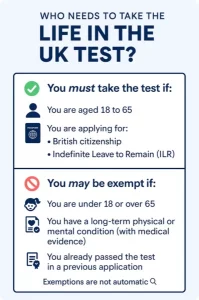
The Life in the UK Test is a computer-based test that you must pass if you want to become a British citizen or apply for indefinite leave to remain. The test is based on the official handbook 'Life in the United Kingdom: A Guide for New Residents'. It covers a wide range of topics about British history, culture, society, laws, and government. The test consists of 24 multiple-choice questions, and you have 45 minutes to complete it. You need to answer at least 18 questions correctly (75%) to pass. The questions are randomly selected from a large bank. You can book the test at official test centers across the UK. You must bring acceptable identification (like a passport or biometric residence permit). The test costs a fee.
Level 82: The Citizenship Ceremony
Title:
Level 82: The Citizenship Ceremony
Body:
If your application for British citizenship is approved, you will be invited to attend a citizenship ceremony. This is a formal event where you make an oath or affirmation of allegiance to the King (or Queen) and a pledge of loyalty to the United Kingdom. The ceremony is usually conducted by a local councilor or registrar and may be held in a civic building like a town hall. You will be presented with your certificate of British citizenship. You can also choose to have a private ceremony or a group ceremony with other new citizens. After the ceremony, you are officially a British citizen and can apply for a UK passport. Citizenship ceremonies reflect the importance and solemnity of becoming a British citizen.
Level 83: Fundamental Principles of British Life
Title:
Level 83: Fundamental Principles of British Life
Body:
The fundamental principles of British life are based on core values that have developed over centuries. They include: democracy (the right of citizens to participate in political decision-making, through voting and standing for office); the rule of law (the principle that everyone, including the government, is subject to and must obey the law); individual liberty (the freedom to live your life as you wish, as long as you do not infringe on the rights of others); tolerance of those with different faiths and beliefs (respecting and accepting diversity in a multi-faith, multicultural society); and participation in community life (taking an active role in your local community, volunteering, and helping others). These principles are not just abstract ideas; they are the foundation of a cohesive, peaceful, and prosperous society.
Level 84: Equality & Diversity
Title:
Level 84: Equality & Diversity
Body:
The UK is a diverse society made up of people from many different backgrounds, cultures, and faiths. The principle of equality means that everyone should be treated fairly and have the same opportunities, regardless of their age, disability, gender, marriage or civil partnership status, pregnancy or maternity, race (including colour, nationality, ethnic or national origin), religion or belief, sex, or sexual orientation. These are 'protected characteristics' under the Equality Act 2010. Discrimination on these grounds is illegal. Promoting diversity means valuing and respecting the differences between people and creating an inclusive environment where everyone can participate and contribute. This diversity enriches British society, bringing new ideas, perspectives, and cultural experiences.
Level 85: The UK’s International Role
Title:
Level 85: The UK's International Role
Body:
The United Kingdom plays an active role in international affairs. It is a permanent member of the UN Security Council, a leading member of NATO (the North Atlantic Treaty Organization), and a member of the G7, G20, the Commonwealth of Nations, the Council of Europe, and the OECD. The UK has a significant diplomatic network and a professional armed forces. It is a major contributor to international development aid and humanitarian efforts. The UK also plays a role in promoting international law, human rights, and democracy. Following its departure from the European Union in 2020, the UK is forging new trade and diplomatic relationships around the world as an independent trading nation. The King is the Head of the Commonwealth, a voluntary association of 56 independent countries, mostly former British colonies.
LEVELS 86-100: EXAM READINESS & FINAL PREPARATION
Level 86: Understanding the Exam Format
Title:
Level 86: Understanding the Exam Format
Body:
The Life in the UK Test is a computer-based multiple-choice exam. You will have 45 minutes to answer 24 questions. The questions are drawn from all chapters of the official handbook. To pass, you must score at least 75%, which means answering at least 18 questions correctly. The questions are randomly generated, so each test is different. You will select your answers using a mouse or touchscreen. There is a review screen where you can see which questions you have answered and which you have skipped. You can go back to change your answers before submitting the test. The test is taken in a secure environment at an official test center, with invigilators monitoring the room. You cannot bring any books, notes, or electronic devices into the exam room.
Level 87: Booking Your Test
Title:
Level 87: Booking Your Test
Body:
You must book your Life in the UK Test online through the official government website (www.gov.uk/life-in-the-uk-test). You will need to create an account and provide personal details, including your name, address, date of birth, and immigration reference number (if applicable). You will also need to upload a passport-style photograph and choose a test center location and date. There are test centers in many towns and cities across the UK. You will need to pay the test fee online by debit or credit card. After booking, you will receive a confirmation email with your test details. It is important to check your booking carefully and contact the test provider immediately if there are any errors. You can reschedule or cancel your test up to 3 days before the appointment, but you may lose your fee if you cancel later.
Level 88: ID Requirements
Title:
Level 88: ID Requirements
Body:
On the day of your test, you must bring acceptable photographic identification. The ID must be the original document (not a photocopy or digital copy) and must exactly match the name you used when you booked the test. Acceptable forms of ID include: a valid passport (from any country); a valid UK biometric residence permit (BRP); a valid UK driving licence (full or provisional, with photo card); a valid European Union national identity card; or a valid convention travel document. If you do not bring acceptable ID, you will not be allowed to take the test and you will lose your fee. Check the official guidance carefully to ensure your ID is acceptable. The name on your ID must exactly match the name on your booking. If you have changed your name (e.g., through marriage), you must bring supporting documents (like a marriage certificate).
Level 89: What to Expect on Test Day
Title:
Level 89: What to Expect on Test Day
Body:
On the day of your test, arrive at the test center at least 15 minutes before your scheduled appointment. You will be asked to show your ID and sign in. You will be shown to a waiting area and then called into the test room. You will be assigned a computer workstation. The invigilator will explain the rules and how the test works. You will have 45 minutes to complete the 24 questions. You can skip questions and come back to them later. You will see a timer on the screen showing how much time you have left. When you have answered all questions, you can review your answers before submitting. After you submit, your result will be displayed on the screen immediately. You will receive a unique pass notification letter (or email) with your pass reference number, which you will need for your citizenship or settlement application.
Level 90: Test-Taking Strategies
Title:
Level 90: Test-Taking Strategies
Body:
To maximize your chances of passing the Life in the UK Test, use effective test-taking strategies. First, read each question carefully. Some questions ask for the correct answer, while others might ask for the incorrect option (e.g., 'Which one is NOT true?'). Second, eliminate obviously wrong answers first to improve your odds if you need to guess. Third, if you are unsure about a question, flag it and come back to it later – don't spend too much time on any single question. Fourth, manage your time. You have about 1 minute 52 seconds per question on average. Check the timer regularly. Fifth, use the review screen to see which questions you have answered and which you have skipped. Finally, stay calm. If you have prepared well, you will have the knowledge needed. Don't panic if you encounter a question you don't know – make your best guess and move on.
Level 91: Common Question Traps
Title:
Level 91: Common Question Traps
Body:
The Life in the UK Test questions are designed to test your knowledge accurately, but there are some common traps to watch out for. Be careful with questions that ask for 'the most important' or 'the main' reason – there may be several correct facts, but you need to select the one that fits the question best. Pay attention to dates – the test often asks for specific years or centuries (e.g., 1066, 1215, 1832). Watch for questions about the four nations – remember which fact applies to England, which to Scotland, Wales, or Northern Ireland (e.g., patron saints, legal systems, devolved powers). Be careful with questions about the monarchy – remember the line of succession and the titles of key royals. Read questions that use negatives (NOT, EXCEPT) very carefully – it's easy to select the correct statement when the question asks for the incorrect one.
Level 92: Final Chapter Review – Values & UK
Title:
Level 92: Final Chapter Review - Values & UK
Body:
This level provides a rapid-fire review of Chapters 1-2: Values and the UK. Core British values: democracy, rule of law, individual liberty, tolerance, participation. The UK consists of England (capital London), Scotland (Edinburgh), Wales (Cardiff), Northern Ireland (Belfast). Great Britain = England + Scotland + Wales. The UK is a constitutional monarchy and parliamentary democracy. The national anthem is 'God Save the King'. The flag is the Union Flag (Union Jack), combining the crosses of St George (England), St Andrew (Scotland), and St Patrick (Ireland). The patron saints: St George (England, 23 April), St Andrew (Scotland, 30 November), St David (Wales, 1 March), St Patrick (Northern Ireland, 17 March). Key national days: Remembrance Sunday (poppies), Bonfire Night (5 November), Trooping the Colour (King's official birthday).
Level 93: Final Chapter Review – Early History
Title:
Level 93: Final Chapter Review - Early History
Body:
Rapid-fire review of early British history. Romans invaded 43 CE (Emperor Claudius), built roads, Hadrian's Wall, left 410 CE. Anglo-Saxons arrived, created kingdoms. Vikings raided from late 8th century. 1066: Norman Conquest, Battle of Hastings (William the Conqueror defeats Harold). Domesday Book (1086) surveyed land. Magna Carta (1215) limited King John's power, established rule of law. Model Parliament (1295) included commoners. Hundred Years' War (1337-1453) against France; victories at Crécy, Agincourt. Black Death (1348-49) killed 1/3 of population, weakened feudalism. Peasants' Revolt (1381) challenged poll tax. Wars of the Roses (1455-1487) between Lancaster (red rose) and York (white rose); ended by Henry VII (Tudor) at Bosworth (1485).
Level 94: Final Chapter Review – Tudors & Stuarts
Title:
Level 94: Final Chapter Review - Tudors & Stuarts
Body:
Rapid-fire review of Tudors and Stuarts. Henry VIII (1509-47): six wives, broke from Rome (1534), established Church of England. Edward VI (1547-53): Protestant reforms. Mary I (1553-58): 'Bloody Mary', restored Catholicism, burned Protestants. Elizabeth I (1558-1603): Golden Age, defeated Spanish Armada (1588), Shakespeare. James VI & I (1603-25): Union of Crowns, Gunpowder Plot (1605), King James Bible. Charles I (1625-49): Civil War (1642-51) against Parliament, executed 1649. Oliver Cromwell (1653-58): Lord Protector, Commonwealth. Charles II (1660-85): Restoration, Great Plague (1665), Great Fire (1666). James II (1685-88): Catholic, deposed in Glorious Revolution (1688). William & Mary (1689-1702): Bill of Rights (1689) established constitutional monarchy.
Level 95: Final Chapter Review – 18th & 19th Centuries
Title:
Level 95: Final Chapter Review - 18th & 19th Centuries
Body:
Rapid-fire review of the 18th and 19th centuries. Act of Union (1707) united England and Scotland as Great Britain. First Prime Minister: Robert Walpole (1721-42). Jacobite Risings: 1715 and 1745 (Bonnie Prince Charlie), defeated at Culloden (1746). Agricultural Revolution: enclosures, new crop rotations. Industrial Revolution: coal, iron, steam, factories; Arkwright, Watt, Stephenson. Slave trade abolished 1807; slavery abolished 1833 (Wilberforce, Equiano). Napoleonic Wars: Nelson wins at Trafalgar (1805), Wellington at Waterloo (1815). Victorian era (1837-1901): Queen Victoria, Prince Albert, Great Exhibition (1851). Reform Acts expanded voting (1832, 1867, 1884). Chartist movement demanded six points. British Empire at its height.
Level 96: Final Chapter Review – 20th & 21st Centuries
Title:
Level 96: Final Chapter Review - 20th & 21st Centuries
Body:
Rapid-fire review of modern Britain. World War I (1914-18): 11 November Armistice. Partition of Ireland (1921): Northern Ireland remains in UK. World War II (1939-45): Battle of Britain (1940), Blitz, Churchill, VE Day (8 May 1945), VJ Day (15 August 1945). Welfare State and NHS created 1948 (Attlee government). Decolonisation: India independent 1947. Windrush generation arrives from 1948. Swinging Sixties: social changes, The Beatles. UK joins EEC (1973). Falklands War (1982). Devolution: Scottish Parliament, Welsh Assembly (1999). Good Friday Agreement (1998) for Northern Ireland. 2016 referendum votes to leave the EU (Brexit). Queen Elizabeth II (1952-2022), King Charles III (2022-). Modern society is diverse and multi-faith.
Level 97: Final Chapter Review – Government & Law
Title:
Level 97: Final Chapter Review - Government & Law
Body:
Rapid-fire review of government and law. UK constitution: uncodified, sources include statute, common law, conventions. Constitutional monarchy: monarch (King Charles III) is head of state but politically neutral. Parliament: House of Commons (650 elected MPs) and House of Lords (appointed peers and bishops). Prime Minister: head of government, leader of largest party in Commons, based at 10 Downing Street. Cabinet: senior ministers. Opposition: second-largest party, with Leader of Opposition and Shadow Cabinet. Elections: first-past-the-post, at least every 5 years, voting age 18. Devolved bodies: Scottish Parliament, Senedd Cymru (Welsh Parliament), Northern Ireland Assembly. Local government: councils provide local services. Legal systems: England & Wales, Scotland, Northern Ireland are separate.
Level 98: Final Chapter Review – Your Role
Title:
Level 98: Final Chapter Review - Your Role
Body:
Rapid-fire review of the citizen's role. Jury service: duty for 18-75 year olds (18-70 in Scotland) to serve on juries in criminal trials. Voting: right to vote in elections if registered. Paying tax: funds public services like NHS, education, defence. Respecting the law: everyone must obey the law. Tolerance: respecting different faiths and beliefs. Community participation: volunteering, helping neighbours. Equality Act 2010 protects against discrimination on 9 protected characteristics: age, disability, gender reassignment, marriage/civil partnership, pregnancy/maternity, race, religion/belief, sex, sexual orientation. Becoming a citizen: requires passing Life in the UK test, meeting residency and language requirements, and attending a citizenship ceremony (oath of allegiance to the monarch).
Level 99: Full Mock Exam Simulation (Set 1)
Title:
Level 99: Full Mock Exam Simulation (Set 1)
Body:
This is a full mock exam simulation. Set a timer for 45 minutes. Answer these 24 questions without looking at your notes. Treat this as if you are in the real test center. Good luck.

1. What is the name of the UK's national anthem? A) Land of Hope and Glory B) Rule Britannia C) God Save the King D) Jerusalem

2. Which of the following is a fundamental principle of British life? A) Absolute monarchy B) Rule by decree C) The rule of law D) State control of the media

3. When did the Romans leave Britain? A) 43 CE B) 1066 CE C) 410 CE D) 55 BCE

4. What was the Domesday Book? A) A religious text B) A survey of land and property C) A collection of laws D) A history of the Norman Conquest

5. What did Magna Carta (1215) establish? A) The right to vote B) That the king's power was not absolute C) The Church of England D) The Union of England and Scotland

6. Which king was defeated at the Battle of Hastings in 1066? A) Harold Godwinson B) William the Conqueror C) Edward the Confessor D) Hardrada

7. Who was the first Tudor monarch? A) Henry VIII B) Elizabeth I C) Henry VII D) Mary I

8. Why did Henry VIII break from the Roman Catholic Church? A) He wanted to become a Protestant B) The Pope refused to annul his marriage C) He wanted to marry Anne of Cleves D) He wanted to dissolve the monasteries

9. What was the Spanish Armada? A) A Spanish trade fleet B) A fleet sent to invade England in 1588 C) A Spanish treasure fleet D) A Spanish naval base

10. Who was the leader of the Parliamentarians in the English Civil War? A) Charles I B) Oliver Cromwell C) Thomas Fairfax D) Prince Rupert

11. What did the Bill of Rights (1689) establish? A) The right to free speech B) The supremacy of Parliament over the monarch C) The right to bear arms D) The abolition of the monarchy

12. When did England and Scotland unite to form Great Britain? A) 1603 B) 1707 C) 1801 D) 1922

13. Who is generally considered Britain's first Prime Minister? A) William Pitt the Elder B) Robert Walpole C) Winston Churchill D) David Lloyd George

14. The Battle of Trafalgar (1805) was a famous naval victory for which British commander? A) Duke of Wellington B) Horatio Nelson C) Francis Drake D) Robert Blake

15. When was the slave trade abolished in the British Empire? A) 1807 B) 1833 C) 1776 D) 1865

16. Who was the monarch for most of the 19th century? A) George III B) William IV C) Queen Victoria D) George IV

17. When was the National Health Service (NHS) founded? A) 1918 B) 1939 C) 1948 D) 1965

18. What was the Good Friday Agreement (1998) about? A) Joining the EEC B) Devolution for Scotland C) Peace in Northern Ireland D) The end of the Cold War

19. What is the role of the monarch in the UK? A) To run the country B) To command the armed forces in wartime C) To be head of state, acting on the advice of ministers D) To choose the Prime Minister from the whole population

20. How many Members of Parliament (MPs) are in the House of Commons? A) 650 B) 750 C) 550 D) 800

21. What is the main function of the House of Lords? A) To make final decisions on all laws B) To elect the Prime Minister C) To revise and scrutinize legislation D) To represent local constituencies

22. In a criminal trial in England and Wales, who decides if the defendant is guilty? A) The judge B) The magistrates C) The jury D) The Crown Prosecution Service

23. What is one of the responsibilities of a UK citizen? A) To vote in every election B) To serve in the armed forces C) To do jury service if called D) To donate to charity

24. What is the pass mark for the Life in the UK Test? A) 50% B) 60% C) 75% D) 85%
Level 100: Final Walkthrough & Success Mindset
Title:
Level 100: Final Walkthrough & Success Mindset
Body:
Congratulations on reaching Level 100! You have completed the full 100-level mastery path. Now it's time for the final walkthrough before your exam.

STEP 1: CHECK YOUR BOOKING
- Confirm your test date, time, and location
- Print your booking confirmation
- Check you have the correct ID (passport, BRP, driving licence) – original documents only
- Plan your journey to the test center: know how you will get there, how long it takes, and have a backup plan

STEP 2: THE NIGHT BEFORE
- Get a good night's sleep (at least 7-8 hours)
- Have a light, healthy meal
- Prepare your ID, glasses (if needed), and any required documents
- Do NOT cram all night – trust your preparation
- Set an alarm and a backup alarm

STEP 3: TEST DAY MORNING
- Eat a good breakfast (protein and complex carbs for sustained energy)
- Dress comfortably in layers (test centers can vary in temperature)
- Leave early with plenty of time to spare
- Arrive at least 15 minutes before your appointment time
- Switch off your mobile phone and any other electronic devices

STEP 4: IN THE TEST CENTER
- Present your ID when asked
- Listen carefully to the invigilator's instructions
- You will be shown to your computer workstation
- The computer will guide you through a tutorial before the test starts (use it!)
- The timer will start when you begin the test

STEP 5: DURING THE TEST
- Read each question carefully
- Watch out for negative questions (NOT, EXCEPT)
- Use process of elimination
- Flag difficult questions and return to them later
- Check the timer regularly, but don't obsess over it
- Stay calm and breathe

STEP 6: AFTER THE TEST
- Your result will be shown immediately on screen
- You will receive a pass notification letter (or email) with your Unique Reference Number
- Keep this safe – you will need it for your citizenship or settlement application
- If you passed: Congratulations! You have achieved a major milestone. Celebrate your success.
- If you didn't pass: Don't despair. You can book another test after 7 days. Review your weaker areas and try again. Many successful people failed the first time.

FINAL MINDSET
You have completed 100 levels of preparation. You have learned about British history, values, government, law, and society. You have practiced with mock exams and reviewed every chapter. You are ready. Walk into that test center with confidence. Trust your preparation. You know this material. Take a deep breath, focus, and show them what you can do.